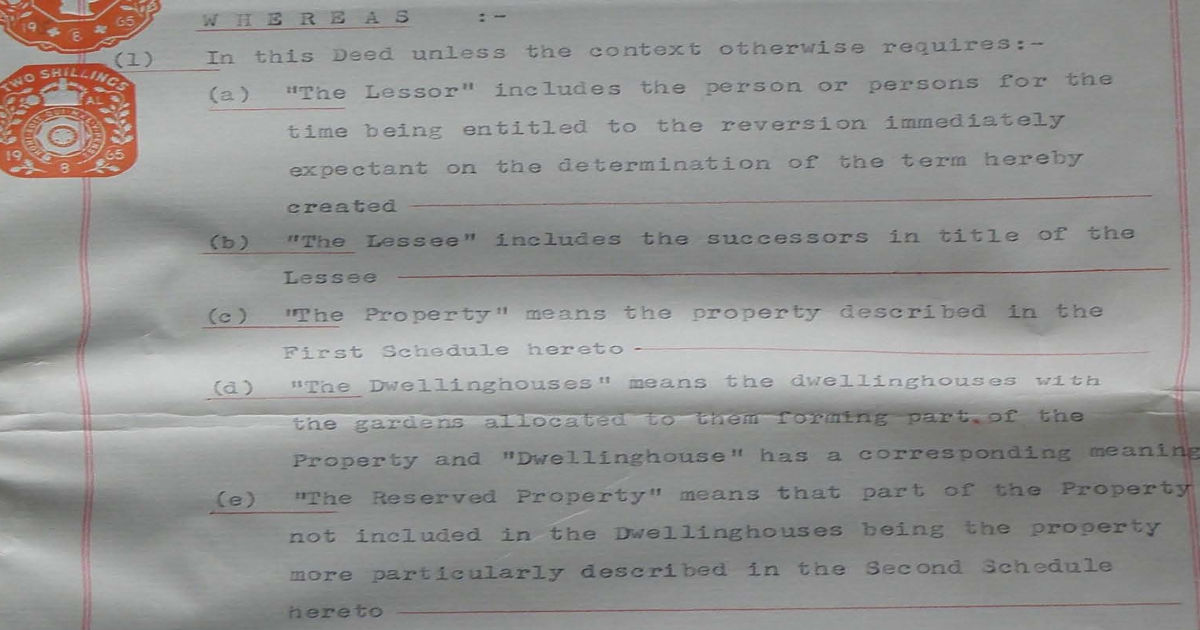
In ordinary English, a reversion is a future event. In land law, it commonly describes the counterpart to a lease as well as the continuing legal estate that remains with the lessor after the grant. The wording of a typical long residential lease explains how and why the legal estate continues to be held by the party that has just sold it:
1. Agreed Legal Fiction and Duty to Hold
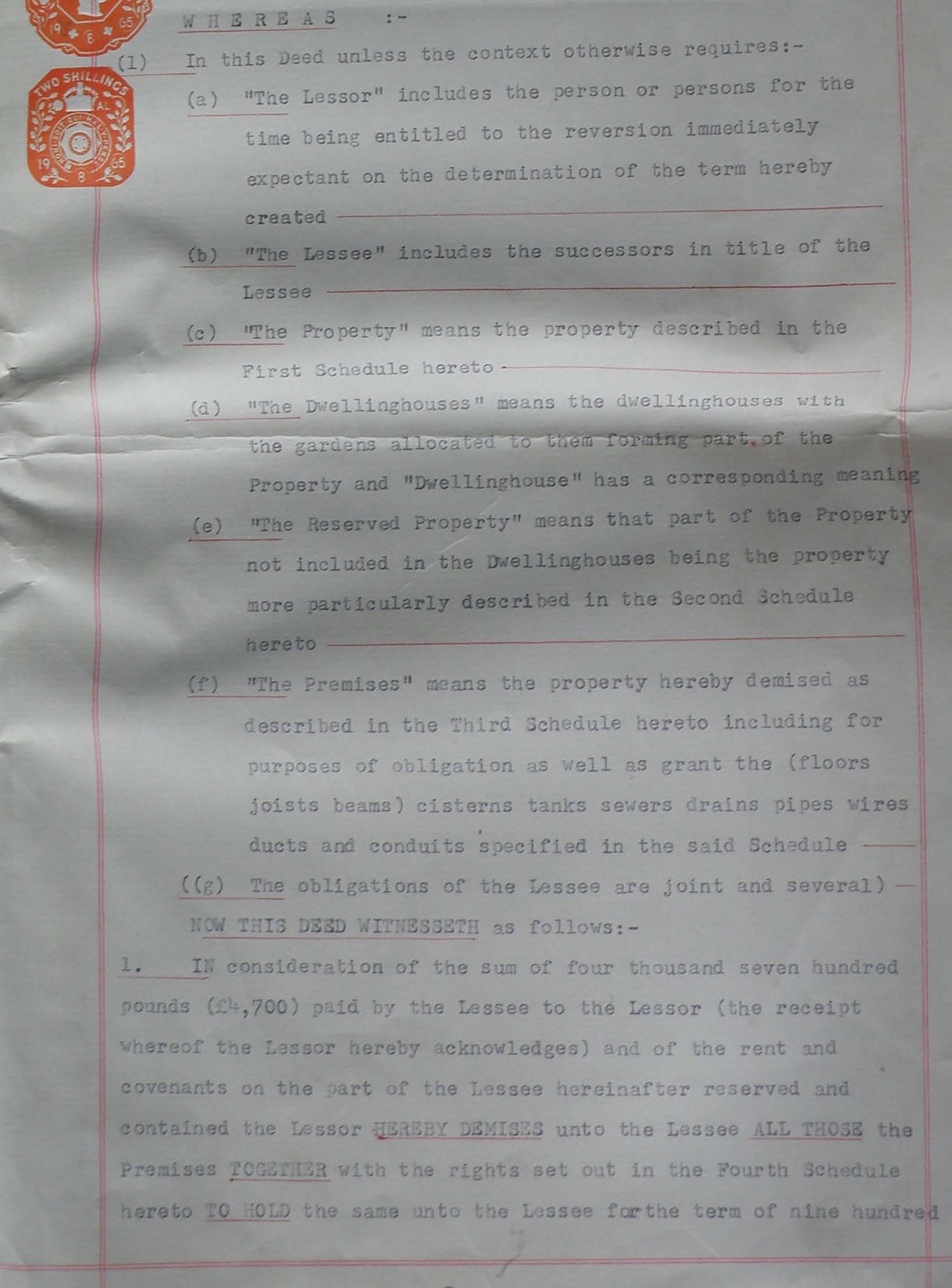
In English law, and in England and Wales alone, the deed evidences an agreed legal fiction: the vendor becomes “the Lessor”, the buyer becomes “the Lessee”, and the Lessor then undertakes, for a large capital sum and a nominal rent, TO HOLD the land unto the Lessee for the term, be it for 99, 125, 250, or 999 years.
The reason for the Lessor’s resulting legal estate is then clear: both the homebuyer and seller agree to a fictional landlord‑tenant contract so that contractual covenants will have force for the duration. The fictional landlord, the Lessor, is TO HOLD the land for that purpose. That purpose is the crux of the bargain, yet public misrepresentations abound, clearly to obfuscate evasion of that prime duty after sale.
2. Public Misrepresentation and Misinformation
External misinformation creeps in regularly, entirely without references.1 The problem with borrowing a convention suited to a 9‑year lease soon emerges when applied to a 999‑year term. Land can be divided in space and in time, but the amount of space and the amount of time obviously affect the significance and substance of the grant; as do attempted revisions of solemn lease deeds through widespread misinformation that likens them to rental contracts. Enormous amounts of cash and wealth are involved nationally, motivating the propaganda.
Mis‑explanation of the word reversion is one such ploy. Curiously, we may note that the re‑entry clause remains triggered after only twenty‑eight days, even for a 999‑year lease. Such an extraordinarily rapid possible reversion is bound to be suspicious. But that is by no means the most serious weakness. Careful reading of land law textbooks reveals that a number of half‑truths about reversions and so‑called reversionary interests are being taught to students.
3. Seisin and Flawed Analogies
We notice that conveyancing of reversions to freehold leases (for lives) was treated differently because the tenant had seisin. Then we note the sentence: “According to feudal principles… a freehold reversioner on a term of years has an estate which is vested not only in interest but also in possession, for the grant of a lease does not deprive a grantor of seisin”.
We remember that freehold is the last remnant of feudal tenure, so these writings begin to look dangerous if taken out of context. If seisin is no longer of importance, the feudal analogy cannot work. Obviously in the modern context of an artificial long lease, the problematic modern analogy is to rental contracts. The problem there is that rentals are, equally, terms of years, so that by muddling seisin, tenure, ownership, and estate, wrongdoers see opportunities to defeat long-lease contracts in everything, at first, bar possession.
Megarry & Wade2 summarise the position by concluding that “although seisin as such is no longer of any importance, a landlord’s reversion is still an ambiguous interest”, presenting a paradox – as the textbook so often finds itself limited and bound to do – without being in a position to provide a judicial clarification where none exists. Let us look at possible solutions to the puzzle.
4. Context: Responsibility, Trust and Public Duty
There is legitimate intuition behind the idea: when land is divided in time, one can imagine a continuum between what the grantor held before the term and what might revert afterwards, especially if the term is short, i.e. for less that 21 years. Similar intuition appears in the spatial analogy to the great estate, where a magnate retained the surrounding whole. But these ideas were confined to contexts where the grantor genuinely retained something, including the vital factors of mutual trust, responsibility, and good faith.
The notion of feudal superiority was rarely used, historically, to justify the kind of betrayals occurring in recent years. When it was, the betrayal was a legitimate cause for removal of the petty tyrant concerned, originally by force, or later by appeal to the Royal Courts. In Ancient Rome and elsewhere for thousands of years, such betrayals were a capital offence. In modern times, fraud remains a crime at common law. Statute specifically rendered evasive disposals void, first in 1278 and 1529 for terms of years, and then utterly void in 1571 for any kind of fraudulent deed. Yet modern land law textbooks introduce the ambiguity without a caveat that criminal law takes precedence. The term of years nowadays is most definitely a legal estate and not a legitimate target for economic tyranny.
5. Modern Misinterpretation of the Reversion
Modern commentary treats the reversion in a long residential lease casually, as if it were always a form of continuing ownership while the physical land is let as if for an ordinary tenancy. This interpretation rests on an ambiguity applied outside its proper context.
Megarry & Wade make the technical point in their discussion of future interests,3 observing that “from this point of view a reversion on a lease is not a reversion or, indeed, a future interest at all”, and support it with a footnote citing Challis4 and De Grey v Richardson (1747). But those authorities were discussing the descent of a fee simple at their time of writing, before the 1925 statute made clear that a term of years is now an estate in land and no longer a mere contractual licence. The observation was correct in the context of legal history, but easily misleads students into thinking it still applies to the reversion from a long term of years.
Where land has been sold on a long or ultra‑long lease, the reversion must be understood strictly in that context and in no other. Seisin either remains of legal significance or it does not; a century after the 1925 legislation, the law still appears undecided.
6. True Source of Title: Contractual Legal Guardianship
A future interest cannot subsist as a legal estate. The lessor’s continuing legal custody in an ultra‑long lease arises precisely and only because the lease deed requires and agrees that the lessor is TO HOLD the land unto the lessee. The deed itself is the source of the dutiful holding of the freehold estate, by contract.
If the agreed term is to run for centuries, the freeholder retains no meaningful ownership beyond the purposes and covenants expressly reserved. The legal relevance of the reversion therefore varies with the length of the term: short commercial leases may leave genuine residual powers; medium‑length terms of twenty‑one to ninety‑nine years leave limited but recognisable interests; and terms of a hundred years or more reduce the reversion to a nominal estate whose practical effect is determined by the covenants and term of years agreed. Although some modern commentary suggests a lack of standard leases, long‑term residential leases have historically followed stable templates, and the deed itself is the only genuine source of continuing legal custody.
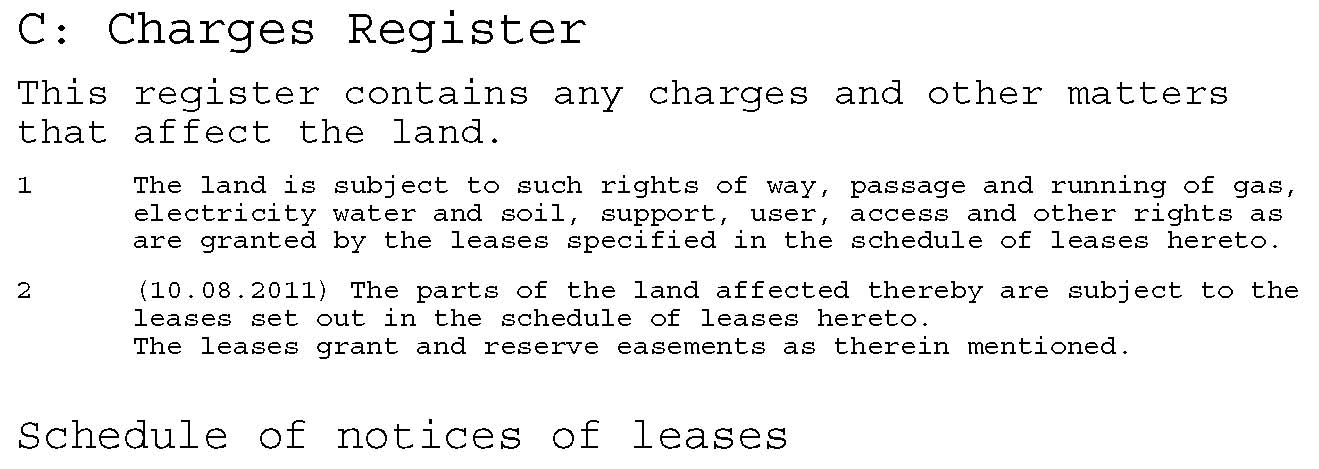
Modern teaching often describes the reversion as if it were a freely transferable abstract interest, moving from L1 to L2 to L3 without affecting the homeowner. This convention may work for short commercial leases, but it breaks down entirely when applied to long residential terms. The homeowner has bought the land for the duration of the term, trusting the corporate vendor, and the lessor’s continuing estate exists only because the deed requires the Lessor to HOLD the land unto the Lessee. Treating the reversion as a commodity that can be offloaded to any third party obscures the true source of title and misrepresents the agreed legal duty. As per Cozens-Hardy L.J. in Stuart V Joy (1904), “The consequence of holding that a landlord can escape from all liability upon his express covenants in the lease by assigning to a pauper would be alarming”. Yet that is precisely what corporations pretend, when they transfer reversions to offshore-owned entities that specialise in exploiting them.
7. Modern Evasive Disposals and Fraudulent Substitutions
Modern practice adopts a theory of ambiguity that is unsupported by fact or law, treating the reversion as if it carried powers that do not arise from the lease. This persists even when the supposed reversionary interest is offloaded to a third party who is not privy to the lease contract. The authority asserted in such cases is not a continuation of ownership. It is a feigned and fraudulent substitution, imposed without consent and without any genuine legal foundation.
The fraud in most cases is designed to evade responsibility for what has been planned, designed, built, and sold. As shown on this site’s Foundations page, Parliament and the courts spent centuries countering collusive disposals and rendering them void. Yet similar disposals have re‑emerged in the twenty‑first century, now presented as if they were legitimate exercises of a reversionary interest – ironically under supposedly ancient legal principles. Government agencies should not support such pretences or the disposals thereby excused. Unfortunately they do, as the public is increasingly aware.
Other than when a true reversionary event is imminent, legalistic use of the words reversion and ground rent when applied to residential long leases suggests intentional ambiguity rather than legality. Such usage is innately suspicious. Yet contemporary practice discourages strong challenge. Under CPR culture, solicitors frame even clear misrepresentation in conciliatory terms, and public bodies often respond defensively. This leaves homeowners without the advocacy that earlier generations took for granted.
- For example as in the Daily Telegraph, 6 July 2026. The article asserts that “Ground rent is a regular payment … for the right to occupy the land the property is built on” and that “In a leasehold property, you own the building, but not the land it sits on.” This is just one of many newspaper, magazine and website articles that repeatedly treat long residential leases as rental arrangements and present ground rent as consideration for mere occupation. ↩︎
- Megarry & Wade, The Law of Real Property (8th ed., 2012, at 9-010, and 9th ed., 2019, at 8-010). ↩︎
- Ibid., 9–010 (heading: “All reversions are vested”). ↩︎
- Challis’s Law of Real Property: Chiefly in Relation to Conveyancing (3rd ed., 1911), ch.VI, p,233. ↩︎