The leasehold term of years survives as one of only two possible estates in land since the 1925 statutes, but in several ways is treated as being inferior to the freehold fee simple. The perceived weakness is foundational, as summarised by Lord Templeman in Street v Mountford (1985):1
“Originally a term of years was not an estate in land, the lessee having merely a personal action against his lessor. But a legal estate in leaseholds was created by the Statute of Gloucester 1278 and the Act of 1529 21 Henry VIII c.15. Now by section 1 of the Law of Property Act 1925 a term of years absolute is an estate in land capable of subsisting as a legal estate.”
So let us now trace how the term of years came to be promoted to an estate in land and why:
1. 1278 The first statutory protection for the Termor
From 1166 the Crown prohibited recovery of land by force, replacing it with the new possessory remedy of novel disseisin. The development had been detrimental to the lessee for years, the Termor. As a contractual licensee he could neither bring nor defend a real action. His possession thus became open to a collusive recovery by a third party. Parliament sought to diminish the vulnerability.
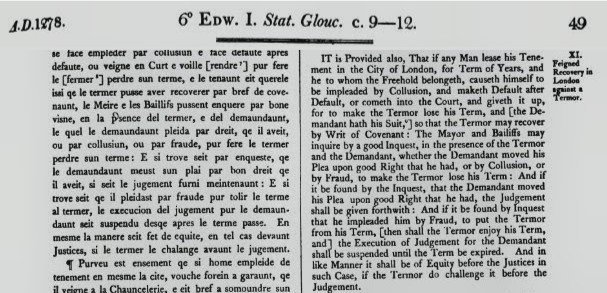
Possession by the Termor first gained protection through the Statute of Gloucester (1278). The wording makes clear that the King’s courts were being misused to oust the rightful Termor, typically after a collusive disposal of the freehold. The new freeholder was entitled to demand possession in the Royal Court. The 1278 statute appointed the Mayor and Bailiffs of London to conduct “good Inquest” where there was evidence of collusion and where the Termor had a writ of covenant in the lower court. If proven, the royal court was to stay execution of possessory judgment for the demandant until the term had run its full course. This was the first statutory indication that a term of years could be something more than a mere contractual licence.
Protection was limited due to procedural demands: The Termor first had to establish a right of covenant, then had to interrupt the new freeholder’s real action between judgment and its execution. But it was a beginning. No further land law statute significantly affected terms of years until 1529. Until then, development continued through the the courts and through necessity, as we shall see.
2. 1340-1399 – Famine, plague, and the rise of necessity
The Black Death (1348–1350) caused social and governmental pressures due to losses of between a third and a half of the population. Statutes attempted to limit labour charges and prices to pre-plague levels but these could not alter harsh economic facts. Surviving tenants needed greater mobility and freedom. Estate owners had insufficient manpower to farm the land as before. A solution was to let farmland to tenants for years. This suited many potential tenants. They were reluctant to bind themselves to a manor with an insufficiently viable population or to a restrictive, service‑based tenure.
The legal system also suffered from lack of personnel while facing new circumstances and demands. New forms of writ and litigation developed during this period, including remedies for termors. These were the formative years when a termor’s possession of land became slightly more reliable. Social changes were perhaps the driving force. The period coincides with the emergence of the English yeoman farmer or forrester, typically loyal but free, well-armed, and capable: the stock that provided longbowmen for the King’s successful battles in France. The free yeoman earned respect.
3. 1400-1499 – The temporary popularity of Terms
For a few decades in the early 1400s, the term of years became the preferred choice because it avoided servitude for the tenant and made economic sense to the estate owner. The owner could sell terms for a capital sum, to let others farm the land with a degree of independence. Termors could negotiate to some extent, and shop around rather than being tied to one lord and locality for life.
Many large estates adapted accordingly, to attract good tenants. Some allowed more copyholds to become freehold, while others reduced the more unpopular aspects of inheritable tenures that they offered. The pendulum swung back a little towards inheritable copyholds “according to the custom of the manor” rather than “at the will of the lord”, with similar easing of other disadvantages. Flexibility increased between inheritable copyhold or freehold and more commerce-based terms of years.
During this fifteenth century the action of ejectment began to emerge as a leasehold possessory remedy. Originally a personal action for the wrongful ousting of a termor, its advantage was that it was effective against third parties rather than being limited to the grantor. This gradually led to the wider adoption of fictitious leases as a means of trying the better right to possession for all kinds of tenure. Its focus on possession made it a swifter and more workable remedy where freehold title itself was disputed. By the end of the century the courts were treating terms of years as chattels real, giving leasehold interests a recognised real‑property character and laying the foundations for ejectment’s later dominance.
4. 1529 – Fermors shall enjoy their Leases against Recoveries
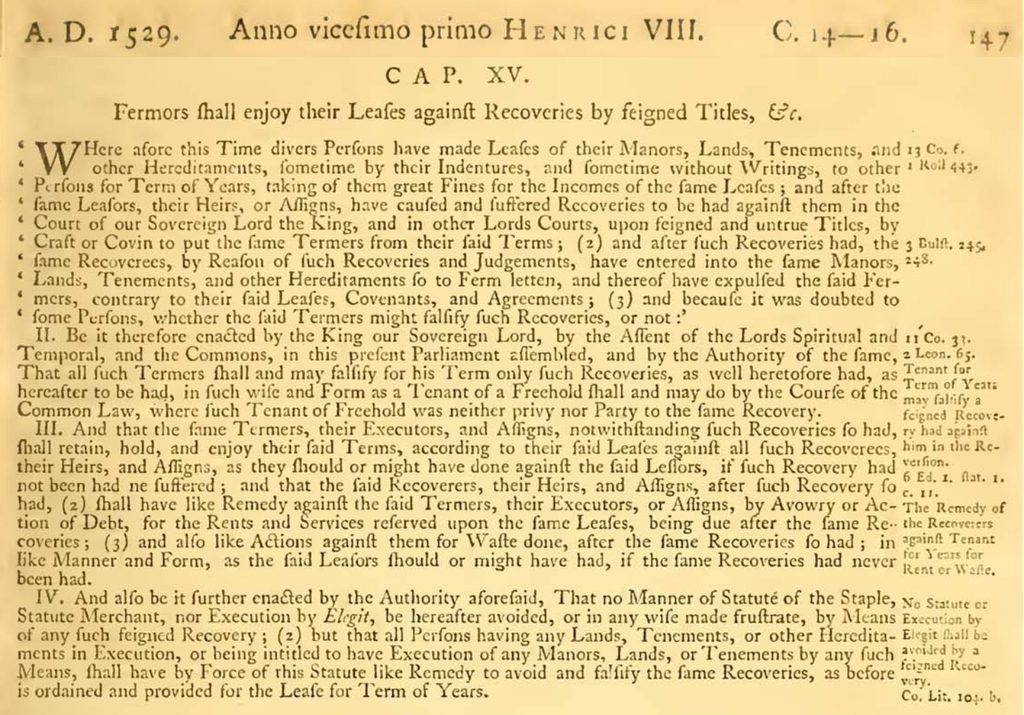
The next statutory development was 21 Henry VIII c.15 (1529). Its evident purpose was again to prevent the King’s courts being misused through feigned and collusive recoveries designed to eject rightful Termor farmers. Parliament intervened because the earlier protection under the Statute of Gloucester (1278), though significant, had left Termors exposed to procedural traps and uncertainty.
A crucial clause reads:
“That all such Termers shall and may falsify for his Term only such Recoveries, as well heretofore had, as hereafter to be had, in such wise and Form as a Tenant of Freehold shall and may do by the Course of the Common Law, where such Tenant of Freehold was neither privy nor Party to the same Recovery.”
This closed procedural loopholes and put leasehold possession on a par with freehold. Unusually, it applied retrospectively: a rightful Termor, with years still to run, could prove a recovery to be false (hence “falsify”) even if it had been effected before the statute. From 1529 onwards, possession was protected, and the wording “enjoy” may be read as echoing the standard implied covenant for quiet enjoyment, undisturbed by the grantor.
The 1529 statute also had a wider procedural consequence. By the end of the fifteenth century (c.1499) the courts were treating terms of years as chattels real, but the remedies available to termors were still weak. Once Parliament gave termors a statutory right to recover possession, the action of ejectment – originally a leasehold recovery – became far more effective. Originating as a leasehold possessory remedy, it developed into the principal method of trying most kinds of title including freehold. Later abolition of the real actions in 1833 ultimately left the former leasehold remedy as the sole survivor.
5a. 1571 – Fraudulent Conveyances Act 1571
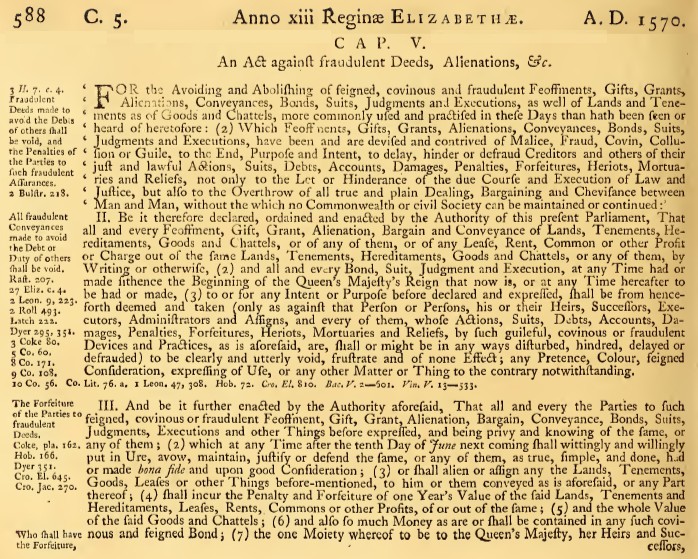
By this statute 13 Elizabeth c.5, Parliament now confronted frauds occurring not only through litigation but through any kind of false deed. The preamble is unusually candid: “For the Avoiding and Abolishing of feigned, covinous and fraudulent Feoffments, Gifts, Grants, Alienations, Conveyances, Bonds, Suits, Judgments and Executions, as well of Lands and Tenements as of Goods and Chattels, more commonly used and practised in these Days than hath been seen or heard of heretofore.”
This statute had two crucial functions:
(a) It declared fraudulent conveyances void, and this remained authoritative for centuries. Blackstone, writing two hundred years later, still cited 13 Eliz. c.5 as the governing statement of when a deed was void for fraud. The principle endured: a fraudulent deed or disposal was not merely defective; it was a nullity, void ab initio, binding only between the miscreants themselves and no‑one else.
(b) It contained a now‑forgotten penalty clause. Anyone who made a fraudulent feoffment, grant, alienation or conveyance forfeited one year’s value of the land, lease or rent, or the full value of any goods or chattels involved. One half went to the Crown; the other to the party or parties grieved. Fraud was both a public and a private wrong at common law, now confirmed by statute.
5b. 1585 – 27 Elizabeth c.4
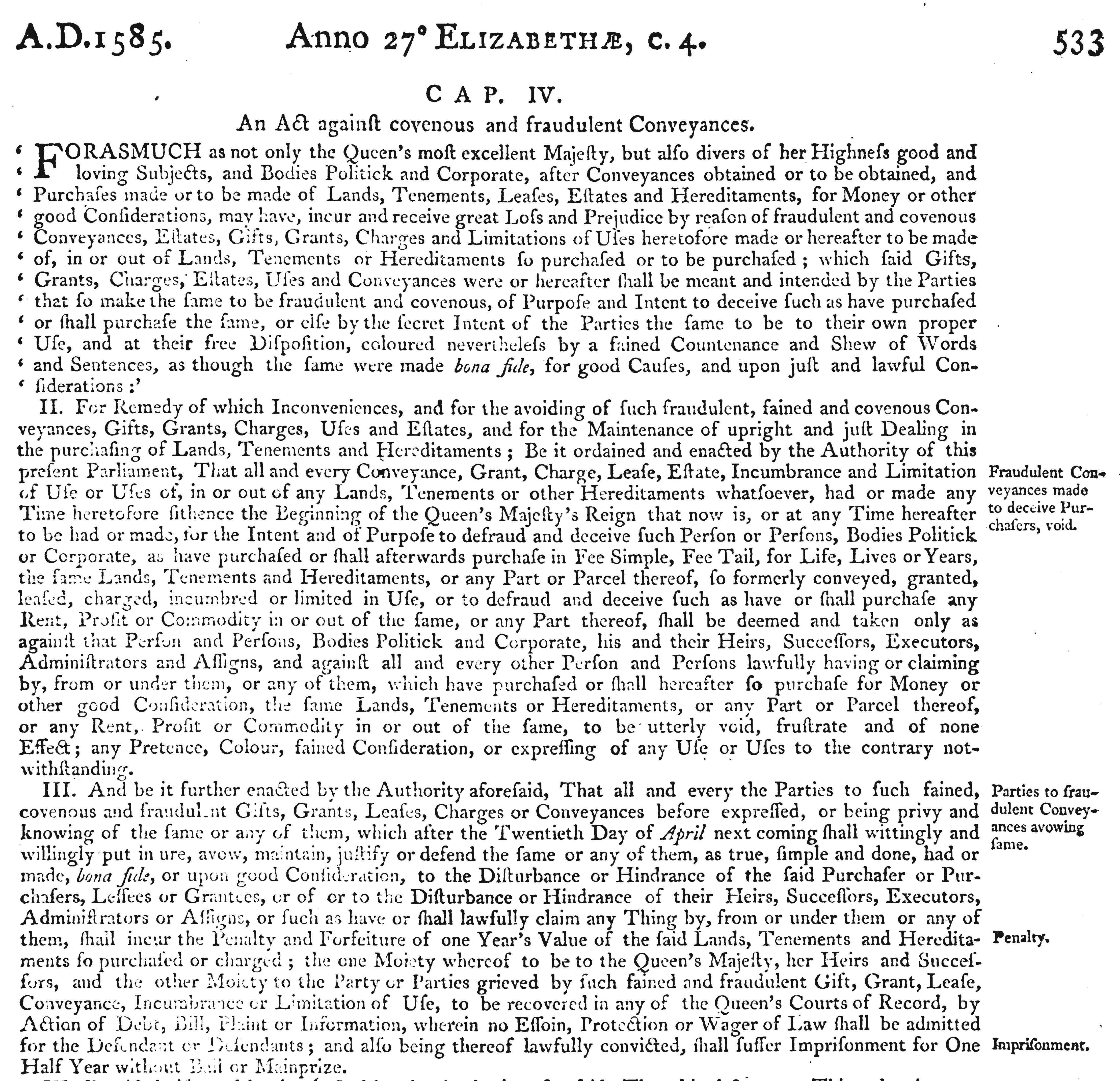
Feigned conveyances were the more specific target of the follow‑up statute 27 Eliz. c.4 (1585), this time adding a half year’s imprisonment to the fixed monetary penalty of a year’s value of the land. Imprisonment would apply to a party who sought to “maintain, justify or defend… as true” a feigned or fraudulent conveyance “to the Disturbance or Hindrance of the said… Lessees or Grantees”. This second statute confirmed and emphasised pre‑existing law and introduced a greater deterrent.
Such conveyances were already void, punishable offences at common law before the statute, as confirmed in numerous cases and in classic legal writing such as those of Bracton, Littleton and Coke. Fraud had always been a structural threat to landholding. Both Elizabethan statutes declared pre‑existing law, confirmed that fraudulent conveyances were void, and both set fixed penalties of a criminal nature. In pre‑registration days, the rightful tenant could simply refuse to attorn to or recognise a false landlord.
6. 1677 – the Statute of Frauds
The Statute of Frauds 1677 formalised evidential safeguards: writing, witnessing, and reliable instruments for transfers of land and interests in land. This was the practical bridge between medieval possession and modern registration. A term of years still counted only as personal property, but it had to be created with the same evidential safeguards as land.
The consensus among legal historians that terms were treated as chattels real by 1499 gains further consolidation here, by statute: the courts and Parliament were aligning the term of years with estates in land for the purpose of fraud prevention. Wonnacott explains that terms for life remained the choice for aristocratic families, while straightforward terms for up to 21 years brought the Lessor more certain termination from the business or commercial point of view.2
7. 1705 & 1737 – Ending the necessity for attornment
Blackstone, writing c.1760, described the ending of attornment as the casting off the last brake on freedom to buy and sell. For modern leaseholders its supposed effect is catastrophic, although that result is due (a) to wishful-thinking misinterpretation, and (b) to changing the wording of the key section in 1925.
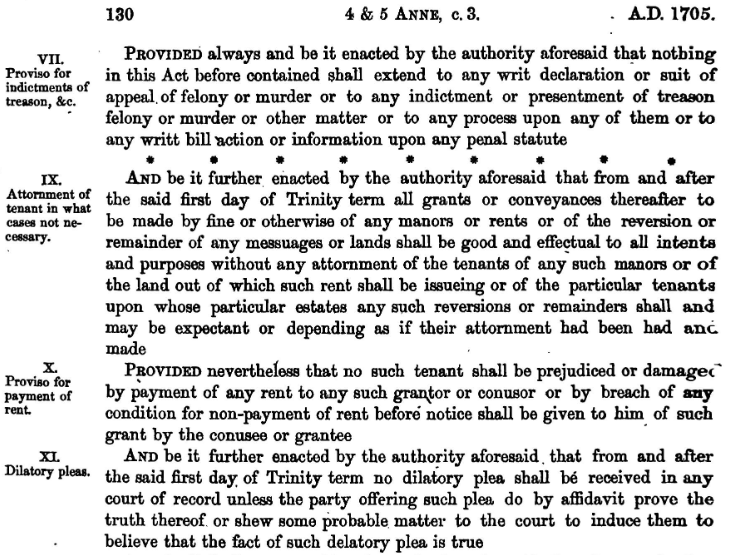
The Statute 4 & 5 Anne c.3 (1705) removed the former conveyancing necessity for tenants to attorn to a new landlord. It was an archaic nuisance to have to consult multiple rental tenants individually before a landowner could sell their own land. In most cases, tenants could be forced to consent in court if they refused without good reason, so attornment had already been skipped, usually, for conveyances that could do rental tenants no harm. Fraudulent conveyances were void at common law anyway, as emphasised since 1571. Possession remained the tenant’s safeguard, the system being based around that inviolable fact or right.
The follow-up 1737 statute shows, in its preamble, that the tenant was almost too powerful, in that some were making positive attornments to feigned landlords, putting the rightful landlord to years of litigation to recover title. The 1737 measure made such attornments void and of no effect.
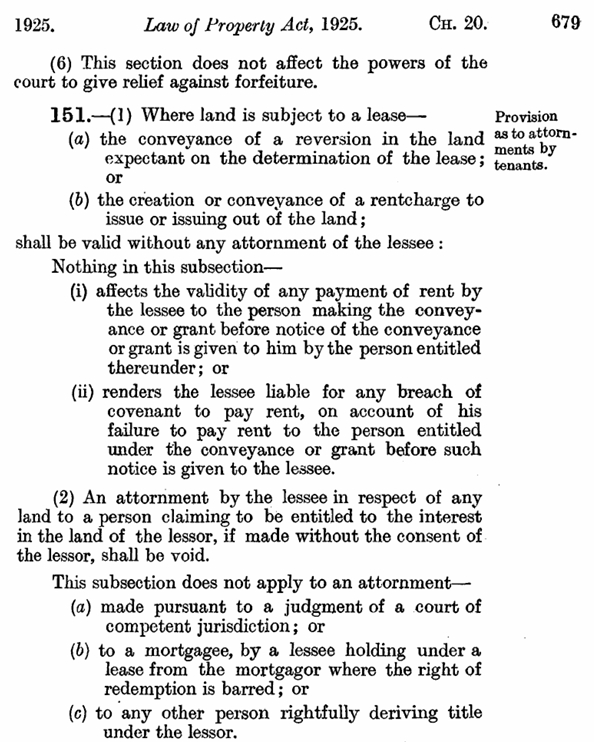
The 1705 and 1737 acts survive through s.151 LPA 1925,3 but were significantly altered:- (a) “tenants of any such manors” has changed to “lessee“, the usual word for the modern leasehold homeowner, and (b) the safeguard contained in s.XI is now absent, or at least appears to be. The 1705 wording of s.XI clearly implies that the tenant must receive prior notice so that they would have the opportunity to lodge an affidavit if aggrieved. As shown on this website, the safeguard derived from common law and must therefore still be there, beneath the smoke and mirrors of systemic bad practice and poor teaching.
Modern practice among miscreants is to give statutory notice only after transfer, which (a) is not contractual notice at all, and (b) is itself evidence of fraud. A fraudulent or voluntary4 conveyance was void at common law, as repeatedly affirmed by the House of Lords. The statutes of Elizabeth were long ago established as merely declaratory of that prior common law.5 Repeal therefore does not affect the fact that non‑consensual disposals are prima facie frauds, typically confirmed by attendant misrepresentations.
However artificial, long leases are intended as contracts. When notice and consent are evaded, no genuine legal contract remains. What follows is not a transfer but a one‑sided imposition. As Bracton put it long ago, “nemo potest consentire quod ignorat“: A man cannot consent to a thing he does not know.6
8. 1800-1925 – The term of years remains a reliable estate in land
By the nineteenth century, mortgages were routinely conducted by way of long lease. Lease and release had used fictitious leases to speed up conveyances of freeholds. Doe v Roe fictitious leases had been used for speedier recovery proceedings. The longstanding protection of possession for the Termor had created multiple practical legal applications that were recognised and protected by the courts. The 1925 property legislation finally formalised the fiction:
A term of years absolute is said, by the statute at least, to be an estate in land.
That was a legal recognition of centuries of necessity, practice, and judicial adaptation.
9. 1925-1985 – building on weakened foundations
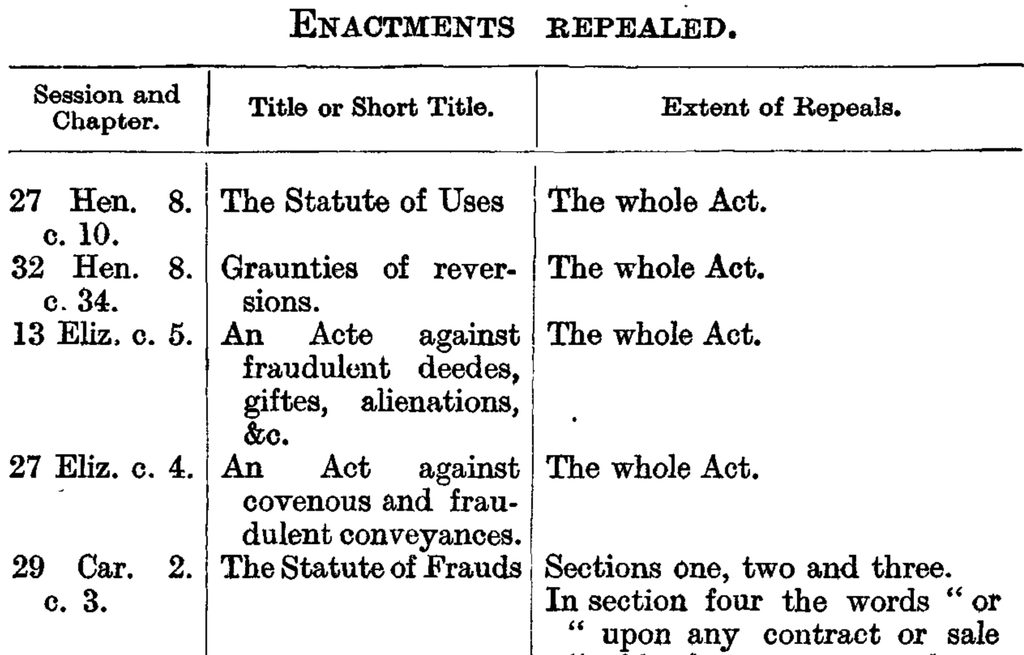
Unfortunately, and crucially for the present housing market, Schedule 7 of the 1925 act repealed the Elizabethan statutes that had emphasised common law protections and had provided deterrent fixed penalties including imprisonment.
Post WW2 housing booms, rent controls,7 and land shortages brought numerous sales of individual apartments without paying attention to the weakened tenure. Flats originally built as rentals were sold on long terms to escape the combination of rent controls and other Rent Act burdens. Local authority stock was sold off for roughly similar reasons and has not been replaced. The private sector has been encouraged to create and sell dwellings of almost any kind, to meet government targets.
The ensuing commercial free-for-all has paid little or no attention to future viability of tenure, that approach aided by academic theories that make pre-planned irresponsibility appear lawful. The sector on the whole plays pass-the-parcel with landlord obligations to an extent that grieved consumers cannot believe possible. Results have taken some time to be publicised, but combined with the more recently-perceived similarity between long-lease and shorter rental contracts, they are disastrous to the entire concept and structure of artificial long leases.
Despite its importance, long leasehold still very much relies on an agreed legal fiction; and legal fiction in turn relies on fraud prevention, due to its innate vulnerability. Historically, fraudulent instruments were void, possession was protected, contractual consent was reciprocal, witnessing, seals, and handwriting mattered on deeds, officials rejected forged documents, and the tenant in possession was secure and reasonably safe. Nowadays, police forces refuse, repeatedly, to enforce the Fraud Act 2006 to protect the common law principles upon which long lease home ownership depends; as do HM Registrars, Trading Standards, the Local Government Ombudsman, and the Solicitors Regulation Authority.
10. The present collapse: why fraud prevention matters
Modern practice and policework has thus abandoned the foundations that used to enable a long lease to function as an estate in land. The Rents Acts have elevated periodic and other rental tenancies to an apparently similar status, so leasehold ownership is easily downgraded and abused. Confusion is being led by subliminal misinformation about ground rents and reversions. Fraudulent disposals go through and become registered, even where the transfer instrument is invalid or forged. No-one checks. Notice to the long-lease owner is omitted and again no-one checks. Long lessees are defrauded, their consent is not sought to disposal, yet officials will not investigate. Regulatory local authorities themselves try to escape responsibility through non-consensual disposals that follow ground rent auctions.8
The main result is predictable:
Impose conveyancing frauds through registration while removing sanctions, and the long‑lease estate collapses. It cannot survive as a true estate in land in these circumstances.
This is not due to ancient law. More the opposite, it is the inevitable consequence of abandoning the common law foundations that made the estate in land workable in the first place.
- Street v Mountford [1985] AC 809, [1985] UKHL 4, [1985] 2 WLR 877. ↩︎
- Wonnacott, The History of the Law of Landlord and Tenant in England and Wales p.131 ↩︎
- Law of Property Act 1925 s.151 (original printer’s version). ↩︎
- Voluntary conveyance is the classic description of a grant that on the face of it lacks genuine consideration. See 6, below. ↩︎
- As confirmed in Rickards v. The Attorney‑General (1845), 12 Cl. & F. 44, House of Lords; and 8 English Reports 1281, per Lord Campbell, “It has been alleged over and over again that that part of the statute is declaratory of the common law. There can be no doubt it is so.” With footnote references: 4 Kent (11th ed.), 462, 463; Bump Fr. Conv. 55, 58; Hamilton v. Russel, 1 Cranch, 309; Peck v. Land, 2 Kelly, 1; Clements v. Moore, 6 Wallace, 209; Hudnall v. Wilder, 4 M’Cord, 294. ↩︎
- Bracton, The Laws and Customs of England written c.1250. ↩︎
- Wonnacott, ibid., p.153 ↩︎
- But remain liable on their covenants as per the Law of Property Act 1925 s.142(2) “This section takes effect without prejudice to any liability affecting a covenantor or his estate.” ↩︎